
Southport's Green Journey
We already live somewhere remarkable
Southport sits on one of the most significant stretches of coastline in the North West. Dunes, pinewoods, saltmarsh and estuary — much of it protected as a Site of Special Scientific Interest, a Special Area of Conservation and a Special Protection Area.
Most of us walk past that fact every day. It's the view from the pier, the dog walk at Ainsdale, the place we take visitors when we want to show off. But it isn't only scenery. Increasingly it's understood — by government, by the NHS, by our own council — as central to this town's health, its wellbeing and its future.
We think that's worth talking about honestly: what Southport already has, what's being planned, and what still needs doing.
Support our work
We're a small Southport CIC and most of what we do runs on goodwill. If you'd like to help us keep the hearth lit — more lunches, more workshops, more time outdoors for people who need it — a donation goes straight into the work.
What we've been doing about it

We'd rather show you than tell you
We fed the town, and talked about the climate while we did it. Our Great Big Green Lunch at Southport Market on 7 June 2026 brought around 250 people together over a shared meal — planned for 150, run entirely on goodwill and a zero cash budget, with a 60-strong choir who joined in. Patrick Hurley MP, the Mayor of Sefton and the Eden Project's Head of Communities all sat down to eat with everyone else.
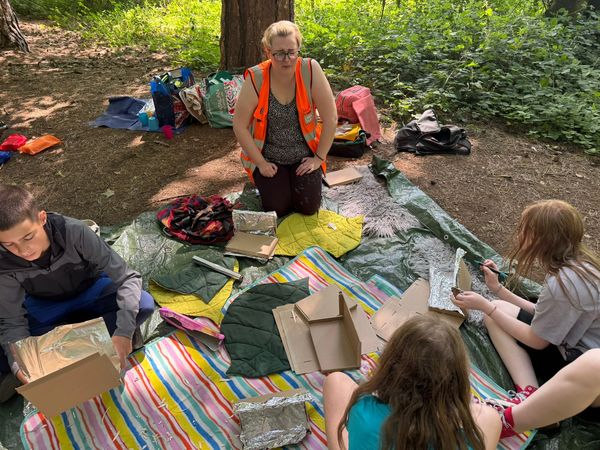
We took young people into the woods, and measured what happened
Roots for Wellbeing ran its first cohort in May and June 2026, delivered with A Gang of Elk Forest School at Ainsdale, on a site Natural England gave us the use of, funded by Sefton CVS.
Afterwards, every single participant said they felt more connected to nature. 92% would recommend it. Enjoyment scored 4.9 out of 5.
We also taught fifteen Girl Guides to mend instead of bin. On 27 June 2026, fifteen girls from the 14th Southport Girl Guides earned their Thrift Badge with us — reimagine, repurpose, reuse.

Mend it, swap it, keep it going
Every week we run sustainable sewing sessions — teaching mending, repairing and upcycling so clothes get worn again instead of going to landfill. Supported by National Lottery Awards for All.
Swish & Stitch adds six community clothes swaps across Southport between August 2026 and February 2027, funded by the Merseyside Recycling & Waste Authority and the Veolia Zero Waste Community Fund.
None of this is grand. It's lunches, workshops, walks and swaps. But it's real, it happened here, and it adds up.
small but impactful
We're a small Southport CIC. Between April 2025 and June 2026, people came to our programmes around 2,200 times. Not 2,200 different people — often the same faces coming back, which is rather the point.

The bigger picture
Two things changed the landscape for Southport recently
The Liverpool City Region launched its first Local Nature Recovery Strategy on 20 March 2026. It sets out 36 priorities for restoring nature across the region, developed with Sefton and the other local authorities. What makes it different from a conservation plan is how much of it is about people: improving access to nature and reducing the inequality in who gets to benefit from it; supporting mental wellbeing and physical activity through parks and green corridors; cooling neighbourhoods with trees; reducing the health impact of flooding and heat through wetlands and natural flood management.
For a coastal town, several of those land very close to home — restoring the coastal habitats that buffer flooding and erosion naturally, improving the water quality that decides how confident people feel about using our own sea, and connecting neighbourhood green space to the coast so that nature recovery also means everyday walking and everyday company.
The strategy is explicit that this only works if it's community-led. That's the bit we intend to hold everyone to, including ourselves.
Sefton Council published its Ainsdale-on-Sea EcoVision in August 2025 — a vision for nature-led regeneration of the Ainsdale coastal gateway, covering Shore Road, Sands Lake and the promenade. Seven objectives, including accessible and inclusive green space, better interpretation of the coast, volunteering and skills, and explicit recognition of what contact with nature does for physical and mental health.
We want to be straight about what that document is. It's a statement of ambition, not a funded delivery plan — no costings, no timetable. The one concrete step so far has been early-stage terms with a private developer to bring the former Sands pub back into use as visitor accommodation. Ambition matters, and we're glad it exists. But ambition isn't delivery, and Southport has been promised things before. It is up to the community, private and public sector to work together to achieve the vision.

Where we fit, and what still needs doing
Turning a strategy into a Tuesday morning
We're not the council and we're not a conservation body. What a small local organisation can do is turn a strategy into a Tuesday morning that someone actually turns up to.
That means gathering first and greening second — a lunch, a workshop, a walk on the beach — because the people who most need time outdoors are rarely the people who sign up for something called a climate event.
It also increasingly means working alongside the health system rather than beside it. Our conversations with Brighter Living Partnership's social prescribing team and with Natural England's green social prescribing work are about making sure time in nature isn't only a nice idea, but something the people supporting someone's health can actually point them towards. We're developing two new programmes in this space — Earth Circles and Earth Walks — for people living with stress, loneliness or grief. Both are in development. When they open, they'll be announced here and in our newsletter first.
And the honest part. Southport's green journey is genuinely being written right now — by the council, by Natural England, by the Combined Authority, and by community groups like ours. But a vision with no costings is not yet a plan. A strategy with 36 priorities needs someone local making sure Southport's share of them actually happens. And access to nature in this town is still uneven: the people with the least green space nearby, the least confidence outdoors, and the most to gain are consistently the people least likely to be asked.
We'd rather say that plainly than pretend the work is done.
What Can You Do Today?
Southport's future will be built by many hands.
Come to something. Our events are free or low-cost, they happen in places you already know, and you don't need to know anything about sustainability to come along.
Hear from us monthly. One letter a month from Southport — what we've been doing, what's coming up, and small ways to join in if you'd like to. Nothing more.